

What Smart Founders Need to Know About the Future of Operations
If your business already feels heavier than it should, the future of operations is not some distant trend to ignore. It is already shaping how your team works, how clients experience your business, and how much of the backend still depends on you. The founders who stay ahead will not necessarily be the ones using the most tools. They will be the ones building stronger systems, cleaner execution, and better operational support before the pressure gets worse.
A lot of founders still think of operations as the behind-the-scenes side of the business that can be cleaned up later. That mindset gets expensive fast. As client expectations rise, delivery becomes more complex, and AI changes how teams work, weak structure gets exposed more quickly. What used to be manageable with founder hustle now becomes a real bottleneck. That is why the future of operations matters so much. It is not just about efficiency. It is about whether your business can grow with more consistency, more visibility, and less founder dependence.
I’m Nikki Pepper, founder of LYFE OS, a fractional COO and embedded operating partner for founders who need stronger systems, structure, and execution to scale without carrying every moving part themselves. At LYFE OS, we help founders step out of day-to-day operations and into the CEO role by building the backend systems, workflows, and operational support their business needs for scalable growth.
In this article, I’m breaking down:
What is changing in the future of operations
Why founders need to care now, not later
What trends actually matter versus what is just noise
And how to position your business for stronger growth as operations continue to evolve
The future of operations is getting more structured, not less
A lot of people hear “the future of operations” and think mostly about new software, AI tools, or automation. Those things matter, but they are not the full story. The bigger shift is that operations are becoming more central to how a business performs.
In the past, a founder could get further with a messy backend if they were willing to stay close to everything. They could answer every question, jump into every issue, and keep things moving through sheer involvement. That is getting harder to sustain.
Why? Because the modern business has more moving parts:
More tools
More communication channels
More delivery layers
More client touchpoints
More expectations for speed and consistency
That means the future of business operations for founders is not optional. It is becoming one of the main factors that determines whether growth feels clean or chaotic. The businesses that run well will not just be creative or well-marketed. They will be operationally stronger.
Rising client expectations are changing what “good operations” means
One major trend founders need to pay attention to is the way client expectations are rising.
Clients expect:
Faster responses
Smoother onboarding
Clearer communication
More polished delivery
Less confusion
Fewer dropped details
Most of those expectations are operational, not just relational.
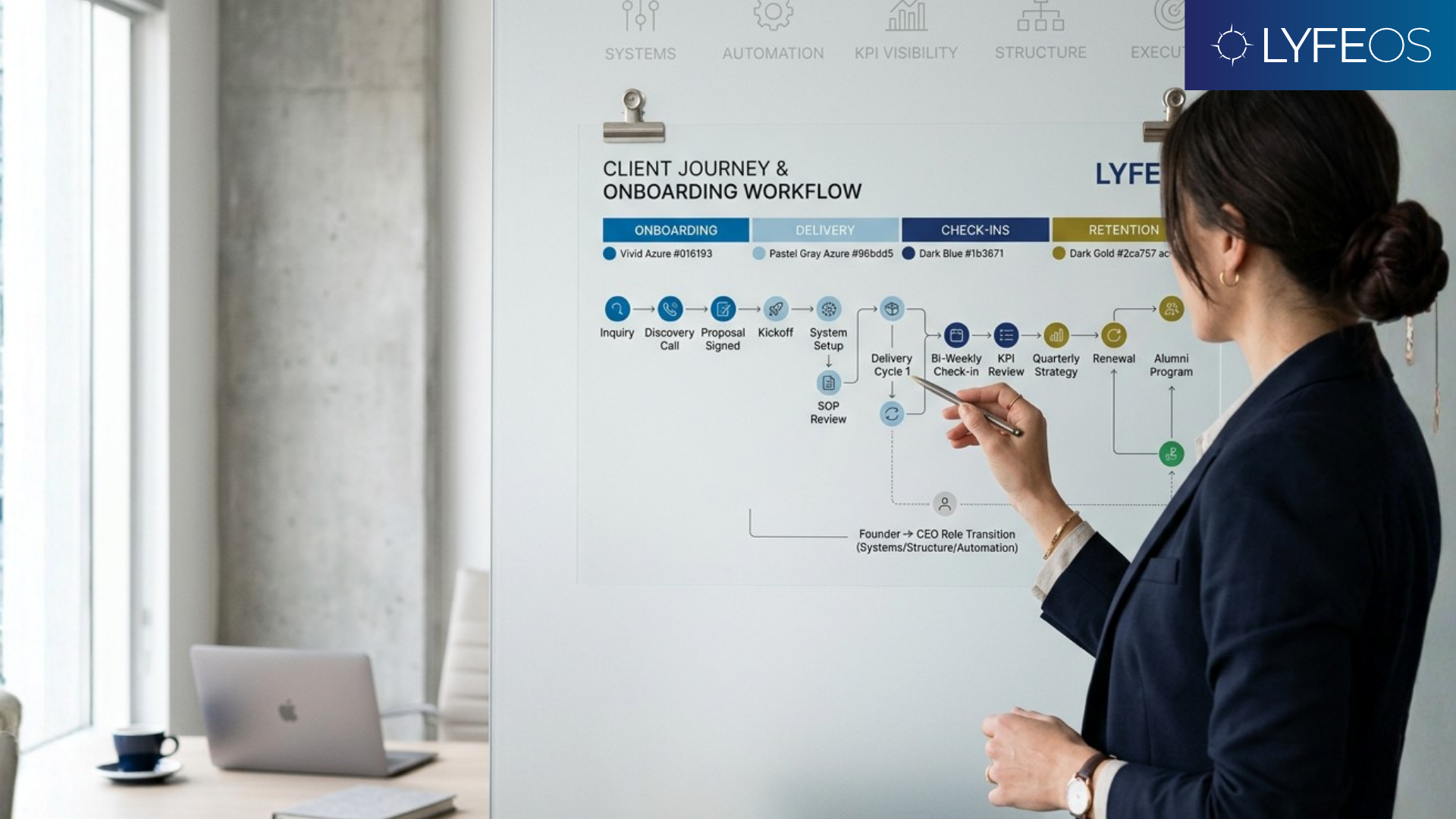
A founder might think they have a sales problem or a team problem, when the real issue is that the client journey is not structured well enough. If onboarding feels clunky, communication is reactive, or delivery is inconsistent, the client experiences that as a quality issue even if the service itself is strong.
That is why the future of operations is so tied to client experience. The backend is no longer just internal. It shapes what the client feels at every stage.
Practical example:
A founder adds more clients and assumes the team can handle it. But onboarding is still manual, welcome materials vary, internal handoffs are unclear, and follow-up depends on someone remembering. The founder ends up stepping in constantly to make sure the client experience stays strong. That is not a capacity problem first. It is an operations problem.
AI is changing how work gets done, but not what good operations require
AI is absolutely part of the future of operations, but it should not be treated like the future all by itself.
The biggest change AI is creating is this: it is speeding up how businesses handle lower-level processing work. It can help summarize information, draft communication, organize ideas, support documentation, and reduce some repetitive tasks. That is useful.
But AI for business operations works best when it sits inside a business that already has some structure.
AI does not replace:
Ownership
Decision-making
Workflow clarity
Quality control
Communication standards
Operational judgment
If anything, AI makes strong operations more important. Why? Because when work moves faster, weak processes get exposed faster too.
Founders should pay attention to AI, but through this lens:
Where is manual work slowing the team down?
Where would better systems make AI more useful?
Where would AI reduce repetitive effort without lowering quality?
Where are we at risk of adding more tools without solving the real issue?
The future is not “AI instead of operations.” It is AI inside stronger operations.
Founder dependence will become harder to hide
Another important shift is that founder-heavy businesses will feel more strained as the operational standard rises.
If your business still depends on you for:
Approvals
Key decisions
Problem-solving
Delivery oversight
Team direction
Communication cleanup
Then growth will keep feeling heavier than it should.
This is where the future of operations connects directly to founder leadership. The businesses that scale well will increasingly be the ones that build operations that do not depend on you for every moving part.
That does not mean the founder becomes uninvolved. It means the founder leads at the right level. They have visibility without hovering. They set direction without being buried in every task. They stay close to the business without functioning as the engine.
This matters because future growth will reward leverage. Not just effort.
Practical example:
Two founders may have similar revenue. One is still reviewing every deliverable, answering constant team questions, and holding delivery together. The other has stronger workflows, clearer ownership, and better tracking. As complexity increases, the first founder feels trapped. The second has room to lead.
That gap is operational maturity.

The businesses that stay ahead will focus on four things
If you want to be proactive about the future of operations, there are four areas worth focusing on now.
1. Stronger backend systems
Your backend systems should make the business easier to run, not more founder-dependent. That means cleaner workflows, better handoffs, stronger documentation, and more consistency across delivery.
2. Better visibility
You should not have to personally chase every update to know what is happening. Founders need clearer visibility into priorities, progress, bottlenecks, and performance without being buried in the weeds.
3. Cleaner ownership
As businesses grow, unclear ownership becomes more expensive. The future of operations will reward teams that know who owns what, how decisions get made, and how work moves forward.
4. Smarter operational support
Founders need better operational support, not just more help. More people does not automatically create more capacity. The support has to strengthen execution, reduce drag, and make the business run more smoothly behind the scenes.
What smart founders should do now
You do not need to predict every shift in business or adopt every new platform. You do need to build a business that is operationally ready for what is changing.
Start here:
Identify where the business still depends too much on you
Tighten one weak point in the client journey
Improve one messy workflow
Clarify ownership where confusion is creating drag
Assess where AI could reduce manual work without adding noise
Strengthen the backend before adding more complexity
That is the practical version of preparing for the future of operations.
The goal is not to look futuristic. The goal is to build a business with more structure, better execution, and more room for the founder to lead.
Conclusion
What smart founders need to know about the future of operations is simple.
The businesses that grow well will not just be the ones with better marketing, more offers, or more tools. They will be the ones with stronger systems, clearer ownership, better visibility, and more reliable operational support behind the scenes.
That is what makes growth sustainable. That is what reduces founder dependence. That is what helps you lead with more focus and less operational drag.
If your business is growing and you want to strengthen the structure behind it before the cracks get wider, Book a discovery call with LYFE OS.. We can look at what is creating the most pressure behind the scenes, where your operations need to mature next, and what would create the biggest lift for your next level.
FAQ
What does the future of operations mean for founders?
It means operations are becoming a more central part of growth. Founders need stronger systems, better ownership, and clearer workflows if they want the business to scale without becoming more dependent on them.
How is AI affecting business operations?
AI is helping teams move faster on repetitive tasks like summarizing, drafting, organizing, and processing information. It works best when it supports a clear workflow rather than replacing structure.
Why do client expectations matter to operations?
Because smooth onboarding, communication, delivery, and follow-up are all operational. As expectations rise, weak systems become more visible to clients.
What should founders improve first?
Start with the area creating the most drag. That is often a weak workflow, poor visibility, unclear ownership, or a messy part of the client journey.