
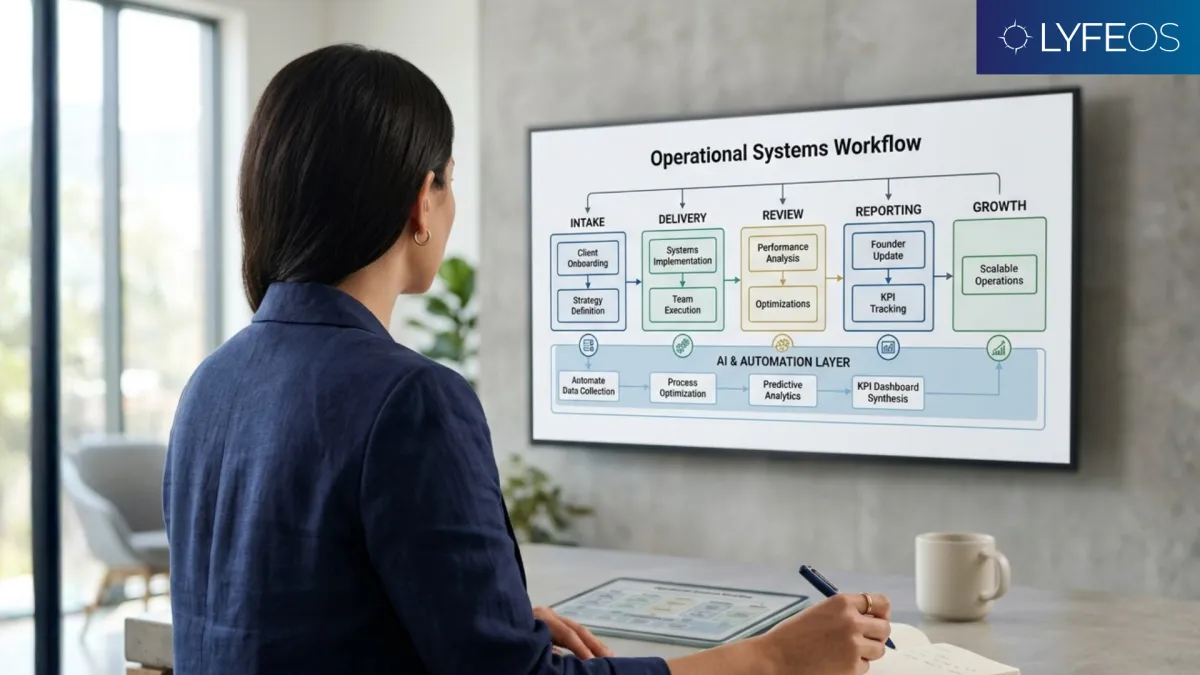
The Back-End Systems Every Founder Needs Before Scaling
If your business already feels full, adding more clients, more offers, or more moving parts will not fix it. It will expose what is already weak behind the scenes. A lot of founders try to grow on top of a backend that is still being held together by memory, manual effort, scattered tools, and constant founder involvement. That is usually why growth starts to feel heavier instead of stronger.
When the backend is not built to support the next level, the founder becomes the workaround for everything. You step in to answer questions, fix delivery issues, keep the team aligned, fill process gaps, and make sure nothing gets dropped. That may keep things moving for a while, but it does not create a business that can scale well. Your website already speaks directly to this. Growth is not the problem. The lack of structure behind it is.
I’m Nikki Pepper, founder of LYFE OS, a fractional COO and embedded operating partner for founders who need stronger systems, structure, and execution to scale without carrying every moving part themselves. At LYFE OS, we help founders step out of day-to-day operations and into the CEO role by building the backend systems, workflows, and operational support their business needs for scalable growth.
In this article, I’m breaking down:
What backend systems actually are
Why they matter before scaling
Which systems every founder needs in place first
And how stronger operations reduce manual work and founder dependence
What backend systems actually mean
Before getting into which systems matter most, it helps to define what backend systems really are.
In simple terms, backend systems are the repeatable structures that keep your business running smoothly behind the scenes. They include the workflows, ownership, tools, automations, communication rhythms, and delivery processes that help work move forward without depending on constant founder rescue.
These are not flashy. They are not usually the part of the business people see first. But they are often the difference between a business that grows cleanly and one that becomes more chaotic as revenue increases.
For founders, this usually includes:
How leads move into the business
How new clients are onboarded
How delivery is tracked and fulfilled
How communication happens internally and externally
How responsibilities are owned across the team
How renewals, upsells, and follow-up are handled
Your services page reflects this clearly through language like onboarding systems, workflow setup, communication processes, delivery and tracking systems, client delivery infrastructure, KPI dashboards, and lifecycle visibility. That is what a real operational backbone looks like.

Why backend systems matter before scaling
A founder can get surprisingly far without strong systems. In the early stage, closeness to the work can compensate for weak structure. You know the details. You know the clients. You can move fast because the whole business is still close to you.
But that stops working once complexity increases.
More clients create more delivery. More team members create more communication and handoffs. More offers create more variation in the client journey. If the systems behind all of that are still weak, the founder becomes the one holding the machine together.
That creates three major problems.
First, manual work multiplies. Every gap in the process becomes another thing someone has to remember, check, fix, or follow up on.
Second, execution becomes inconsistent. One client gets a smooth experience. Another gets confusion, delays, or missed details. The issue is rarely effort. It is usually missing business systems and processes.
Third, the founder gets pulled back into the weeds. Instead of leading the business, you are constantly supporting the backend because the backend cannot fully support itself yet.
This is exactly why the LYFE OS resources page focuses on operations that do not depend on you, messy operations, and the systems founders need before scaling.
The core backend systems every founder needs before scaling
Not every business needs the same exact setup, but there are a few core systems most founders need in place before adding more complexity.
1. A clear client journey from start to finish
One of the most important systems is a mapped and consistent client journey.
That means the experience from:
Lead to inquiry
Inquiry to sale
Sale to onboarding
Onboarding to delivery
Delivery to retention, renewal, or next offer
If these transitions are still messy, unclear, or overly manual, growth will magnify the friction.
A strong client journey system should answer:
What happens after someone inquires?
What does onboarding include?
Who owns each stage?
How are expectations communicated?
What are the key milestones and follow-ups?
Your homepage and services page both emphasize client journey and experience as a key part of what LYFE OS builds. That is a sign that this is not secondary. It is foundational.
2. Delivery and fulfillment systems
If your delivery still depends too much on you remembering details, checking every step, or manually moving work along, this is one of the first places to tighten.
This includes:
Project or client tracking
Fulfillment workflows
Recurring deliverables
Internal handoff points
Quality control steps
Follow-up processes
Strong delivery systems reduce dropped balls, improve client experience, and create more reliable execution. They also reduce how much mental energy the founder has to spend keeping everything in motion.
3. Communication rhythms and ownership
A surprising amount of operational drag comes from unclear communication.
If your team is unsure where to ask questions, when to update progress, how to escalate issues, or who owns which decision, the founder often becomes the communication bridge for the whole business.
This is where stronger communication rhythms and ownership matter.
That may include:
Weekly team check-ins
Clearer project update rhythms
Decision-making lanes
Role ownership by function
Expectations around response times and approvals
This is part of how you build operational support that actually reduces founder dependence instead of creating more work to manage.

4. Tool and automation structure that supports the workflow
Tools do not solve operational problems by themselves. But the right tool setup can support cleaner execution.
This includes making sure your existing platforms match your actual workflow, not just the way things have been patched together over time.
That may involve:
Simplifying your tech stack
Making sure tools are being used intentionally
Building automations where they reduce manual work
Removing duplicate effort across platforms
Creating clearer visibility across tasks, delivery, and tracking
Your website consistently reinforces automation, tech infrastructure, systems optimization, and advanced workflows as part of the LYFE OS approach.
5. Visibility into what is working and what is not
A founder cannot lead well if they only know what is happening when something goes wrong.
This is why visibility matters so much. Not because you need a complicated dashboard for everything, but because you need enough operational insight to lead without being buried in every detail.
That can include:
Progress visibility across client work
Delivery status
Retention or renewal touchpoints
Team accountability
KPI dashboards where relevant
Your services page names KPI dashboards and lifecycle visibility directly, which is a strong sign that your brand already sees visibility as part of operational leadership, not just reporting.
What to fix first if your backend feels weak
If your backend is not where it needs to be, do not try to build everything at once. Start where the business feels heaviest.
Ask yourself:
Where are we still too manual?
What part of delivery feels inconsistent?
Where does work keep routing back to me?
What stage of the client journey feels the weakest?
What would create the biggest lift if it ran more smoothly?
That approach aligns closely with the reflection questions on your contact page, which ask founders what feels harder, slower, or more manual than it should and what support or structure would create the biggest lift.
For many founders, the first right move is not adding more. It is strengthening the operational base underneath what already exists.
This is where working with a business operations consultant or embedded operating partner can help. The right support helps assess what is missing, prioritize what matters most, and build the systems in the right order so the business can support growth more reliably.
Conclusion
Before you add more clients, more offers, or more complexity, your backend needs to be ready to carry the next level well.
The most important backend systems are the ones that reduce manual work, improve delivery, strengthen the client journey, create clearer ownership, and make the business less dependent on constant founder involvement.
That is what supports scalable growth. Not more pressure on the founder, but stronger systems, structure, and execution behind the business.
If your business is growing but the backend is not keeping up, Book a discovery call with LYFE OS. We can look at where the friction is, what systems are missing, and what kind of operational support would create the biggest lift next.
FAQ
What are backend systems in a business?
Backend systems are the internal workflows, tools, ownership structures, automations, and delivery processes that help the business run smoothly behind the scenes.
Why do backend systems matter before scaling?
Because growth adds complexity. Without stronger backend systems, more clients and more delivery usually create more manual work, more founder involvement, and more inconsistency.
What backend system should a founder fix first?
Start with the area causing the most friction. For many businesses, that is client onboarding, delivery tracking, ownership, or internal communication.
Can a founder build backend systems without hiring a full-time operator?
Yes. Some founders work with a business operations consultant or fractional COO to assess, build, and strengthen the backend before hiring for a full-time internal role.