

How AI Is Changing Operations, Automation, and the Future of Scaling
If you already feel like your business is carrying too much manual work, AI can look like both the answer and another distraction. On one hand, it promises speed, efficiency, and automation. On the other, it can easily become another layer of noise if your backend is already scattered. More tools do not automatically create better operations. In many cases, they just expose where the business still lacks structure.
That is why the real conversation is not whether AI matters. It does. The better question is how AI is changing operations, automation, and the future of scaling in a way that actually helps founders build stronger systems, cleaner execution, and less founder dependence. That question matters because the businesses that use AI well will not just move faster. They will likely operate with more consistency, better visibility, and stronger support behind the scenes. That fits closely with the LYFE OS positioning around scalable growth, backend systems, operational support, and helping founders step out of day-to-day operations.
I’m Nikki Pepper, founder of LYFE OS, a fractional COO and embedded operating partner for founders who need stronger systems, structure, and execution to scale without carrying every moving part themselves. At LYFE OS, we help founders step out of day-to-day operations and into the CEO role by building the backend systems, workflows, and operational support their business needs for scalable growth.
In this article, I’m breaking down:
How AI is changing operations and automation right now
What shifts founders should actually pay attention to
Where AI supports better scaling, and where it creates more mess
How to think about the future of scaling without chasing every new platform
AI is changing operations by speeding up lower-level work first
The biggest operational shift AI is creating is not that it replaces leadership. It is that it speeds up the lower-level work that used to take far more manual time.
That includes things like:
Drafting internal documents
Summarizing calls and meetings
Organizing ideas into clearer action steps
Turning transcripts into written assets
Helping teams process information faster
Reducing repetitive communication tasks
For founders, this matters because operational drag often comes from repeated mental labor. It is not always glamorous work, but it is the work that keeps the business moving. When AI reduces the time spent on those repetitive tasks, it creates more room for better decision-making and stronger execution.
This is especially relevant for business operations for founders because so many founders stay buried in lower-level work longer than they should. AI can support the shift out of that by helping clean up the processing layer of the business. It can help turn messy information into something usable faster.
A practical example would be a founder who finishes a team meeting and still has to turn a long discussion into action items, ownership, deadlines, and follow-up. AI can help create the first pass quickly. That does not remove the need for judgment, but it reduces the manual work needed to get from conversation to execution.

AI is making automation more accessible, but not automatically better
Automation used to feel more technical and harder to implement. AI is lowering that barrier in some ways by making it easier to draft workflows, generate process documentation, and support faster setup.
That is useful, but it can also be misleading.
Just because automation is easier to create does not mean it is the right automation to build. If the process underneath it is unclear, the automation will likely reinforce confusion instead of fixing it.
This is where founders need to be careful. AI is making automation more available, but the future of scaling will still favor businesses that have stronger structure first.
For example, if your client journey still has unclear handoffs, inconsistent onboarding, or scattered communication, adding AI on top will not suddenly make that experience smoother. It may speed up parts of it, but it will not solve the structural issue. Your services page already reinforces this through its focus on client journey, backend infrastructure, workflows, communication processes, and lifecycle visibility. AI fits best when those foundations are becoming stronger, not when they are missing altogether.
So yes, AI is changing automation. But the real takeaway is this:
automation is becoming easier to build, while operational clarity is becoming even more important.
The future of scaling will reward businesses with stronger systems
A lot of founders hear “AI” and think mostly about content, marketing, or speed. But from an operational perspective, the bigger long-term shift is this: businesses with stronger backend systems will be in a much better position to use AI well.
That is because AI works best when it sits inside a business that already has:
Clearer workflows
Clearer ownership
Stronger communication rhythms
Cleaner data and documentation
More consistent delivery standards
In other words, AI can strengthen a business that already has a solid operating structure. It is much less helpful in a business where everything still depends on founder memory, manual fixes, and scattered tools.
This is one reason the future of scaling will likely look different than the past. Founders used to get away with holding a lot of the business together personally for longer. Now, the gap between a well-structured company and a founder-dependent one will likely become more obvious faster.
Why? Because businesses with stronger systems will be able to:
Implement AI more smoothly
Create more reliable automation
Move information faster
Improve delivery without adding as much manual strain
Create more consistent operational support behind the scenes
That supports scalable growth in a much more real way than just stacking more tools onto a messy business.
What founders should actually pay attention to right now
The future of scaling does not belong to founders who try every new platform. It belongs to founders who understand what needs to become stronger operationally and then use AI in service of that.
There are four shifts worth paying attention to.
1. AI is becoming part of the workflow layer
It is no longer just a stand-alone tool. It is increasingly becoming part of how teams draft, summarize, organize, and move work forward. Founders should think about where AI fits into existing workflows, not just which tools sound impressive.
2. Speed is becoming easier, but quality control matters more
If AI makes it easier to create content, documentation, automations, and internal assets faster, then the differentiator becomes accuracy, judgment, and operational fit. Review still matters.
3. Founder dependence will become easier to spot
If some businesses are able to reduce manual work and improve execution through AI-supported systems, founder-heavy operations will feel even heavier by comparison. This does not mean every founder needs to automate everything. It does mean weak structure will become harder to ignore.
4. The businesses that win will use AI strategically, not reactively
The strongest approach is not “Where can I use AI everywhere?” It is “Where is manual work slowing the business down, and how can AI support a cleaner system there?”
That is a much more grounded lens, and it aligns much more closely with LYFE OS.
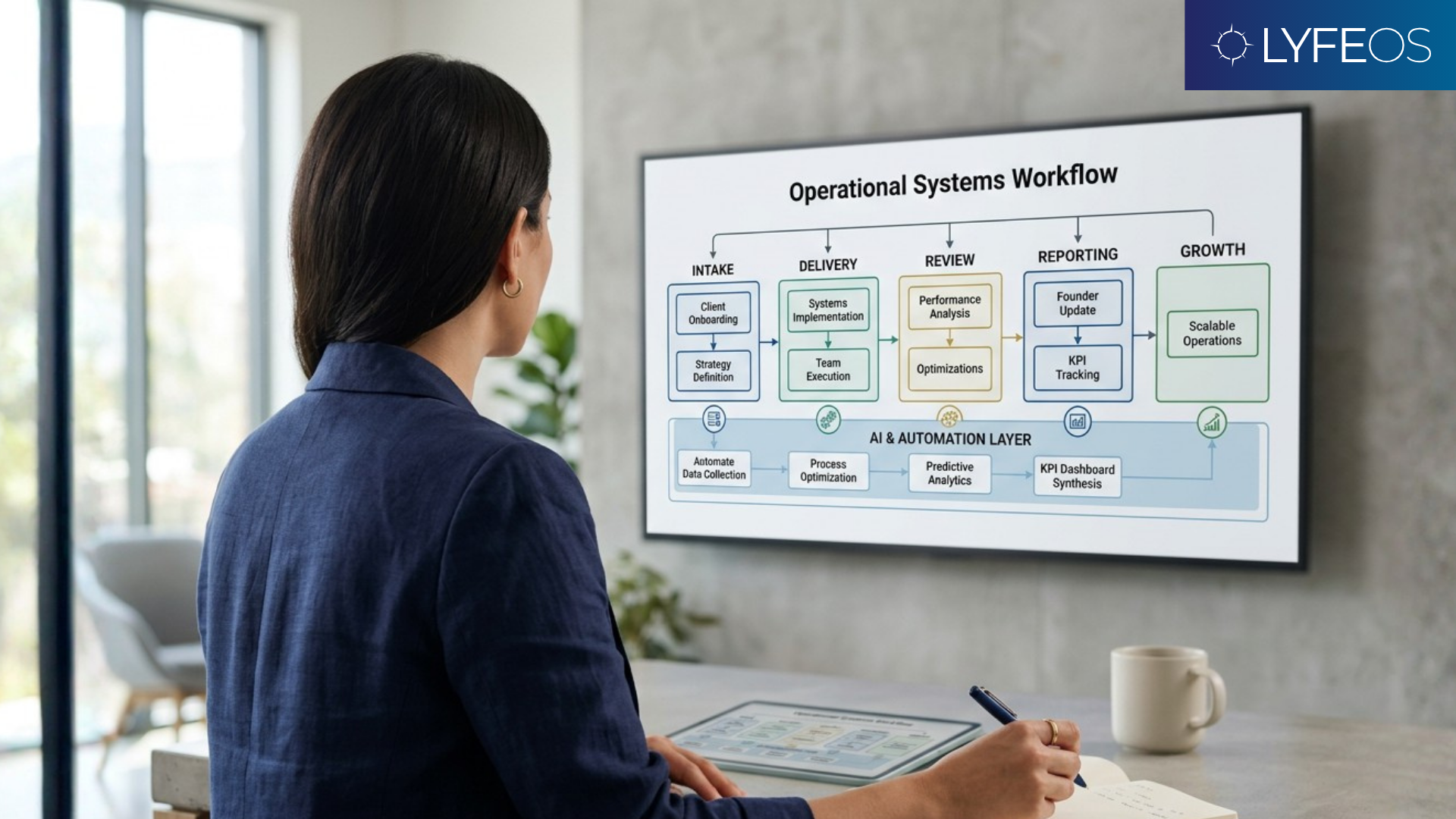
Where founders should be cautious
Not every AI use case is worth pursuing.
Founders usually run into problems when they:
Add multiple AI tools without a clear use case
Automate a process they have not defined yet
Trust outputs without review
Use AI to avoid doing the harder systems work
Create more fragmented workflows across the team
This is where AI can start pulling attention away from what really matters. If the business already feels scattered, more tools can easily become more operational drag.
A better rule is:
Fix the process before automating it
Fix the ownership before speeding it up
Fix the structure before scaling it
That is especially true for AI for business operations. It should support the business becoming cleaner, more consistent, and less founder-dependent. It should not become another thing the founder has to manage personally because the team or workflow is not set up clearly enough.
Conclusion
AI is changing operations, automation, and the future of scaling by making it easier to process information, reduce manual work, and speed up execution. But the founders who benefit most will not be the ones who chase every tool. They will be the ones who use AI inside stronger systems, clearer workflows, and better operational structure.
That is the real shift to pay attention to.
The future of scaling is not just faster. It is more structured. More visible. More repeatable. More supported behind the scenes. AI can help with that, but only when it is used in service of stronger backend systems, better execution, and more reliable operational support.
If your business is growing and you want to think more strategically about how AI fits into your operations, Book a discovery call with LYFE OS. We can look at where manual work is slowing the business down, what systems need to become stronger first, and how AI may fit into a more scalable operational structure.
FAQ
How is AI changing business operations?
AI is helping teams move faster on repetitive work like drafting, summarizing, organizing, and processing information. It supports execution by reducing manual effort, but it works best when the underlying workflow is already reasonably clear.
Will AI replace the need for strong systems?
No. Strong systems matter even more as AI becomes more common. If the process is messy, AI usually speeds up the mess rather than fixing it.
What is the best way for founders to use AI right now?
A good place to start is with lower-risk, high-repeat tasks such as meeting summaries, first-draft documentation, communication drafting, and organizing internal information. These save time without requiring the founder to reinvent the whole business.
What should founders avoid with AI?
Avoid adding tools without a clear operational purpose, automating unclear workflows, and relying on AI outputs without review. AI should reduce friction, not create another layer of it.